Multimedia • Reference • Religion • Travel |
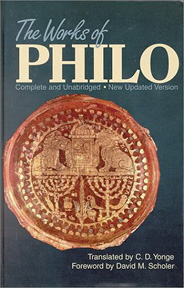
 The Works of Philo: Complete and Unabridged, New Updated Edition Philo Judaeus Translated by C. D. Yonge 
 Description From The Publisher: While it would not be correct to say that Philo's works have been "lost" — scholars have always known and used Philo — they have essentially been "misplaced" as far as the average student of the Bible is concerned. Now for the first time in nearly 140 years the translation of the eminent classicist C. D. Yonge is available in an affordable, easy-to-read edition, with a new foreword and newly translated passages, and containing supposed fragments of Philo's writings from ancient authors such as John of Damascus. The title and arrangement of the writings have been standardized according to scholarly conventions. A contemporary of Paul and Jesus, Philo Judaeus, of Alexandria, Egypt, is unquestionably among the most important writers for historians and students of Hellenistic Judaism and early Christianity. Although Philo does not explicitly mention Jesus, or Paul, or any of the followers of Jesus, Philo lived in their world. It is from Philo, for example, that we learn about how, like the Gospel of John, Jews (and Greeks) in ancient Mediterranean spoke of the creative force of God as God's Logos. Philo, too, employs interpretive strategies that parallel those of the author of Hebrews. Most scholars would agree that Philo and the author of Hebrews are drawing from the same, or at least similar, traditions of Hellenistic Judaism. With these kind of connections to the world of Judaism and early Christianity, Philo cannot be ignored. About the Author Philo, usually known as Philo the Jew (Philo Judaeus) or Philo of Alexandria (a city in Egypt with a large Jewish Diaspora population in Greco-Roman times), lived from about 20 B.C. to about AD. 50. He is one of the most important Jewish authors of the Second Temple period of Judaism and was a contemporary of both Jesus and Paul. Yet, Philo is not nearly as well known or as frequently read as the first century AD. Jewish historian Josephus. His family, of a sacerdotal line, was one of the most powerful of the populous Jewish colony of Alexandria. His brother Alexander Lysimachus was steward to Anthony's second daughter, and married one of his sons to the daughter of Herod Agrippa, whom he had put under financial obligations. Alexander's son, Tiberius Alexander, apostatized and became procurator of Judea and Prefect of Egypt. Table of Contents Publisher's Preface Foreword: An Introduction to Philo By David M. Scholer Preface to the Original Edition On the Creation (De Opificio Mundi) Allegorical Interpretation, I (Legum Allegoriae, I) Allegorical Interpretation, II (Legum Allegoriae, II) Allegorical Interpretation, III (Legum Allegoriae, III) On the Cherubim (De Cherubim) On the Birth of Abel and the Sacrifices Offered by Him and by His Brother Cain (De Sacrificiis Abelis et Cain) That the Worse Is Wont to Attack the Better (Quod Deterius Potiori Insidiari Soleat) On the Posterity of Cain and His Exile (De Posteritate Caini) On the Giants (De Gigantibus) On the Unchangeableness of God (Quod Deus Immutabilis Sit) On Husbandry (De Agricultura) Concerning Noah's Work as a Planter (De Plantatione) On Drunkenness (De Ebrietate) On the Prayers and Curses Uttered by Noah When He Became Sober (De Sobrietate) On the Confusion of Tongues (De Cofusione Linguarum) On the Migration of Abraham (De Migratione Abrahami) Who Is the Heir of Divine Things (Quis Rerum Divinarum Heres) On Mating with the Preliminary Studies (De Congressu Quaerendae Eruditionis Studies) On Flight and Finding (De Fuga et Inventione) On the Change of Names (De Mutatione Nominum) On Dreams, That They Are God-Sent (Quod a Deo Mittantur Somnia or De Somniis) On Abraham (De Abrahamo) On Joseph (De Iosepho) On the Life of Moses, I (De Vita Mosis, I) On the Life of Moses, II (De Vita Mosis, II) The Decalogue (De Decalogo) The Special Laws, I (De Specialibus Legibus, I) The Special Laws, II (De Specialibus Legibus, II) The Special Laws, III (De Specialibus Legibus, III) The Special Laws, IV (De Specialibus Legibus, IV) On the Virtues (De Virtutibus) On Rewards and Punishments (De Praemiis et Poenis) Every Good Man Is Free (Quod Omnis Probus Liber Sit) On the Contemplative Life or Suppliants (De Vita Contemplativa) On the Eternity of the World (De Aeternitate Mundi) Flaccus (In Flaccum) Hypothetica: Apology for the Jews (Apologia Pro Iudaeis) On Providence: Fragment I (De Providentia, I) On Providence: Fragment II (De Providentia, II) On the Embassy to Gaius: The First Part of the Treatise on Virtues (De Virtutibus Prima Pars. Quod Est De Legatione Ad Gaium) Questions and Answers on Genesis, I (Quaestiones et Solutiones in Genesin, I) Questions and Answers on Genesis, II (Quaestiones et Solutiones in Genesin, II) Questions and Answers on Genesis, III (Quaestiones et Solutiones in Genesin, III) Appendix 1: Concerning the World Appendix 2: Fragments Subject Index Index of Old Testament Scriptures Cited in Notes Maps Customer Reviews Write your own online review. Look for Similar Books by Subject  Reference & Bible HelpsHistoryThe Philo Index: A Complete Greek Word Index to the Writings of Philo of AlexandriaWorks of Josephus Josephus and the New Testament Reference & Bible HelpsHistoryThe Philo Index: A Complete Greek Word Index to the Writings of Philo of AlexandriaWorks of Josephus Josephus and the New Testament  | |||||||
  Copyright ©1996-2012 CenturyOne Bookstore. All Rights Reserved. All prices subject to change and given in U.S. dollars. Your purchase from CenturyOne.com will assist the CenturyOne Foundation in providing funding for various archaeological and research projects which seek to provide more information about the period of the First Century C.E., the origins of Christianity and the world of the Bible in general. All materials contained in http://www.centuryone.com are protected by copyright and trademark laws and may not be used for any purpose whatsoever other than private, non-commercial viewing purposes. Derivative works and other unauthorized copying or use of stills, video footage, text or graphics is expressly prohibited. |